
The Unity of Science
“The scientific world-conception
Hans Hahn, RUdolf Carnap, and Otto Neurath, 1929
serves life, and life receives it.”
The Scientific Conception of the World: The Vienna Circle
A SUMMARY: By Constantino Themelis
By: Otto Neurath, Rudolf Carnap, and Hans Hahn, 1929
ORIGINAL HERE: https://rreece.github.io/philosophy-reading-list/docs/the-scientific-conception-of-the-world-the-vienna-circle.pdf
The Scientific Conception of the World was written jointly by Hans Hahn, Otto Neurath, and Rudolf Carnap, the three spearheads of the Logical Empiricism movement as a declaration of faith. Perhaps the word faith is misused here, considering their collective hatred of blind belief and mysticism. However, their strong tone against intuition based philosophy, and for the application of logical analysis to the materials of the factual sciences.
The paper outlines the Vienna Circle’s two defining traits:
- Empiricism and Positivism
- Logical Analysis
To start with their empiricism and positivism, the paper outlines that all legitimate knowledge originates in sensory experience. It rejects profoundly the idea of synthetic a priori, as Kant had proposed. Even mathematics and logic which are necessary and tautological, do not have factual information about the independent world. Logical analysis was an area of philosophy they sought to build upon from Frege and Russell. To those in the Vienna Circle, modern symbolic logic offered tools for reasoning far more useful than that of Aristotle’s syllogistic reasoning. Using these tools, they aimed to reformulate everyday scientific propositions into precise formal language, eliminating ambiguity and unveiling the structures behind systems. From these systems followed their major project, Unified Science. At its core, its goal is integrating all scientific knowledge into a coherent whole using a logical framework. Entailed from this is reducing theoretical theorems to empirical theorems, and discarding pseudo problems that arise from linguistic confusion.
Metaphysics to the logical empiricists of the Vienna Circle was the enemy, mistaken, but more than that it was meaningless (scientifically speaking). Claims of metaphysical nature cannot be tested empirically and this can’t be connected to sensation or observation. ‘Essence’ and ‘noumena’ were concepts better fit for poetics rather than legitimate contributions to the advancement of knowledge. They targeted everything from scholastic and platonic metaphysics to Kantianism and more disguised metaphysics (like realism or idealism that rely on unverifiable entities). The proper role for philosophy was not to generate new knowledge about reality but to clarify the language and logic of science.
The paper proposes a hierarchical construction of knowledge, starting from sense data and building upward. Beginning with observation sentences, which are directly tied to perceptual experiences, we can conceive of physical objects and laws which are constructed from observation statements using logical definitions. Social phenomena can then be constructed, grounded in the physical world. Finally we can formulate special sciences like biology and sociology within the physicalist framework. In this model, science maps structural relations among physical phenomena given to us through sensation rather than seeking to uncover essences or something of that sort.
The paper moves on to the implications of the logical empiricism movement on various different disciplines, from mathematics and logic to the social sciences. Mathematics and logic and logic was going through a crisis of foundation at the time, with the logicism of Russell, formalists, and intuitionists clashing over the fundamentals of mathematics. They favored logicism, to put it briefly, but this problem would be blown open by mathematician Kurt Gödel two years later. Moving on to physics, the members of the Vienna Circle built upon the works of Mach and Poincaré in distinguishing empirical from conventional elements in theory. Moreover, relativity theory, considering its rejection of absolute space and time exemplified their principle that fundamental frameworks can be subject to revision. They move on to the rest of the special sciences, emphasizing the separation between empirical geometry and mathematical geometry, with influence from the recent development that relativity required non-Euclidean frameworks. In biology they declared their support for mechanistic approaches, in psychology toward behaviorism, and in the social sciences for the adoption of statistical and sociological methods.
The mission and purpose for advocating empirical and positivist methodology was not purely academic. The three giants of logical empiricism make it clear that their vision was cultural progress. Clarity, empiricism, and logical rigour promoted rational public discourse, countered mystical superstition, and supported in their view, democratic and socialist government reforms. Uniting the sciences meant not just better science, but an intellectually integrated and socially responsible worldview.
CORE MEMBERS: Moritz Schlick, Rudolf Carnap, Otto Neurath, Hans Hahn, Kurt Gödel, Philipp Frank, Friedrich Waismann, Herbert Feigl, Viktor Kraft.
ASSOCIATES: Hans Reichenbach (Berlin Circle), Frank Ramsey, Wilhelm Blaschke, Arne Næss.INTELLECTUAL INFLUENCES: Albert Einstein (relativity), Bertrand Russell (logicism), Ludwig Wittgenstein (Tractatus).
Superfluous Entities or Occam’s Razor
A SUMMARY: By Constantino Themelis
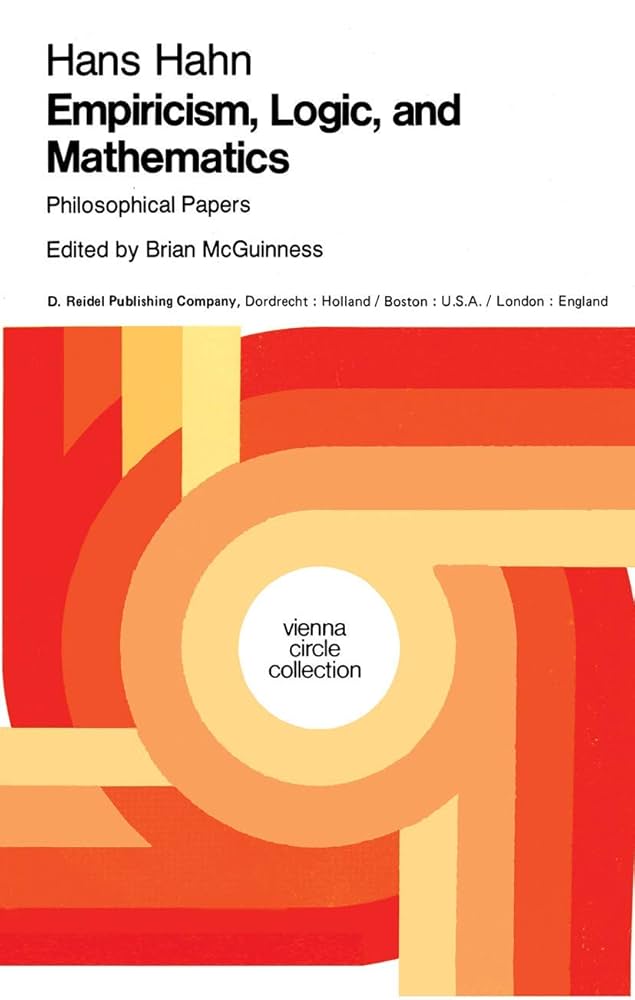
By: Hans Hahn, 1930
In his paper titled “Superfluous Entities”, Hans Hahn distinguishes between the two fundamental attitudes in philosophy. The first is what he calls, “world affirming philosophies”. These are the non-skeptical attitudes, which accept the world as it is, even with all its irregularities and change. The frameworks embrace that sense experience is the basis of reality. “World denying philosophies” distrust the senses, and views the apparent world as deceptive. There fore they search for the “true” entities behind the apparent world, whether they be pure beings, forms, things-in-themself and such. Appealing to metaphysical absolute appeals to those who feel dissatisfied with the empirical world, giving a consolidation by the postulation of another, truer realm.
Hahn turned to tracing the historical dominance of world-denying philosophies, from the likes of Plato, to the medieval scholastics, to the phenomenologists of his time, noting their appeal in offering certainty. However, he argues that their persistence arises from psychological tendencies rather than philosophical rigour.
Hahn, like many of the logical empiricists, often bashed the scholastics as philosophers blinded by religion, unable to do meaningful philosophical analysis. THere was one scholastic, Willem of Occam, who commanded a certain respect and interest from the likes of Hahn and others. Occam’s main philosophical contribution was “Occam’s Razor” a principle that Hahn believed aligned with his world-affirming philosophy: Do not multiply entities without necessity/more explanatory power. Occam was in the nominalist tradition which rejected metaphysical universals in favor of positing only particular, sensible things. General terms were linguistic conveniences rather than pure existing concepts. Hahn concurs with Occam on this point, stating that many philosophical pseudo-problems, whether they be universals, time, space, or numbers, stem from the overestimation of either thought or language, reifying concepts into entities.
Through examples like the concept of “horse”, time as indivisible points, and numbers as independent objects, Hahn aims to show how metaphysics can manufacture abstractions that are unnecessary in understanding our world. Science and everyday life manage perfectly without positing extra entities, we work with colors, shapes, and durations, not some metaphysical substrata that mysteriously zaps us into spontaneous understanding.
Ultimately, Hahn is a world-affirming empiricist who advocated for a philosophy that was grounded in the sensible world, no farther. The task for philosophers is not to posit hidden, supersensory realities but to clarify how we can use concepts to expose pseudo-problems in philosophy, and cut away unnecessary superfluous metaphysical entities.
 logicalempiricism.org